A Teacher in the Backwoods of Amherst County, Virginia
 |
| Fanny Kyle Holt, mid-1890s? |
Fanny Kyle left Leadville, Colorado at the end of June 1889 to return to Virginia. From the date of her arrival in Virginia on June 16th through mid-October, she stayed in Pedlar Mills in Amherst County, living as a boarder in the home of the Woods family: Isabella "Bell," James, Pembroke, Evelyn, Ruth, and Edward. She clearly admired Bell Woods and the rest of the family, but needed to earn an income (she wrote of working for about six days in a canning factory owned by Mr. Woods, canning peaches, but didn't like it and never asked for any pay).
In many of her letters, Fanny shows her extreme lack of self-confidence. She frequently opines on her state of unreadiness for the teaching exam as well as her expected-inability to "get a school" for the winter months. At one point, on 14 September, an old friend came by the Woods' house for a visit and Fanny was distressed because she was having trouble studying, "I really can't study and really don't think I can stand an examination...I wish I were good for something." She sat for the Teaching Examination in September and was awarded her teaching certificate for the State of Virginia shortly thereafter, which was good through the end of the school year.
 |
| Fanny Kyle's Teacher's Certificate for Amherst County, Virginia, for the year ending 31 July 1890. In her October 13th letter to Taylor, Fanny states that Mrs. Woods told her she had "a very creditable exam" and she herself believed that she "came out tolerably well." She said she didn't have the courage to sit for the exam in 1888, and it was only with Mrs. Woods encouragement and support that she did in 1889. |
Fanny told Taylor in a letter dated, 13 October 1889, that she had been appointed to a “district school" up by Allwood. She was told it was a very nice neighborhood and was excited at the prospect of earning a salary of $25/month over five months. She was hoping to have enough money left over to pay off Mrs. Woods and the dentist (note: though I have many receipts for Fanny from the late 1880s, none are for a dentist, so I don't know what she owed him for). She is expecting to be very busy and have a good time.
Though she clearly adored the Woods family, Fanny left Pedlar Mills on the weekend of the 19/20th of October, for "Forks of Buffalo." She describes it as the "canebrakes" of Amherst - a place where people "live so quietly they won't get anything from the outside world but a weekly country newspaper, and won't care to send to the post office more than once a week..." There, she boarded with the family of George Washington "Wash" Dodd and his wife, Amanda. It seems from the outset that she was unhappy in this home, as detailed in her letters to Taylor written between October 22, and December 7, 1889. On October the 22nd she writes,
I am boarding with a Mrs.[Amanda] Dodd. I think they have about forty-eleven children and grandchildren. There is no privacy and it is abominable. I have to sleep in the room with ever so many girls and children and with Miss Belle Dodd. And the children have more curiosity and run and peer into my satchel when I open it and watch me all the time. They are backwoodsy and abominable.
The Dodd family was indeed a large one. In the 1880 census, their household included ten children ranging from the youngest, Ellen (actually Ella Dora), at age nine, to son, James, age twenty-nine. Just next door is another son, George Jr. (age twenty-five) and his young wife, Bethenie, with sons, Andrew and Bernard. Two older children, son Edward, and daughter, Virginia, who appeared in the household in the 1870 census were not there in 1880. Edward and his wife, Sallie, and four children, were just a few households away in the same district; Virginia Dodd died at age twenty-one in 1873. Without an 1890 census to compare to, I can't be sure of how many of the children and grandchildren lived in the household, but there were at least twenty-three grandchildren by November 1889 when Fanny lived there.
Fanny's trust in the Dodds slowly erodes as she accuses them of not passing on her letters from Taylor nor delivering the ones she sends to the post, or - even worse - reading both her letters and those from Taylor! It got to the point that she walked an extra two and a half miles to Allwood in order to use the post office there.
She writes very little about the teaching position itself, aside from one or two mentions of assembling reports to send in. In a letter dated October 30, 1889, Fanny tells Taylor that she has to maintain an average of twenty students each day over the course of the month in order to earn the full salary of $25 per month (equivalent to ~$880 in 2026). As her letters continued, it became clear that she would not meet that goal, which caused her great distress.
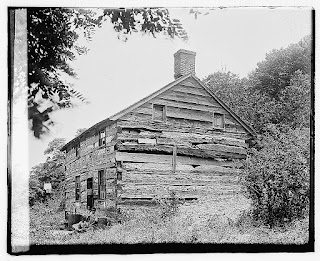
According to an article published by the Virginia Museum of History and Culture (VMHC), free and public schools were enshrined into Virginia law with the Virginia Constitution of 1869, but it was a struggling system in the early days. At the time Fanny was teaching there, Amherst county schools were open for an average of 98 days in a year. Although I haven't found any photos for it, yet, the school at Forks of Buffalo itself was likely a single room wooden or log structure, like the one pictured below, with benches for the students to sit on.
 |
| Log School House at Duckbill Farm, Madison Heights, Amherst County, Virginia, ca. 1920. Though not the school house in Forks of Buffalo, it is likely that the school was much like this one on the home farm of Fanny and Taylor's daughter, Royall Holt Tyler. This school house now stands at the Amherst Museum and Historical Society in Amherst. |
On one occasion, 13 November 1889, Fanny wrote to Taylor from the schoolhouse where she was all alone because it was raining too hard for the students to come to school. She wrote,
I think it is rather hard though for me to have to lose days just because the children don’t choose to come to school when it rains. Of course I will have to make it up on Saturday or break into another week. My salary this month (and all the others, for that matter) will be a mere pittance anyhow...But what is this old school going to amount to? I won’t get $15 per month.
Attendance in rural areas was not regular and also not compulsory, so Fanny would have had a job getting students to come to school each day. Though local governments would pay the salaries of the teachers, the parents had a big role to play in the formation of the school, so Fanny's struggle with the Dodds was quite important for her job safety - especially so if they had been instrumental in getting the school together to begin with. While that is never explicitly stated by Fanny, she does allude to it in a letter at the end of November in which she states that she thinks the Dodds would soon break up the school. The VMHC article noted that teachers were responsible for drawing and keeping students and that salaries would be cut when the numbers reached below a certain threshold.
The article also mentions that teachers were expected to discipline the children in their classes. While Fanny never mentioned much about that, it seems clear that one of her Pedlar Mills neighbors, a man named "Bud" Pleasants, definitely remembered that aspect of school.
 |
| Excerpt from the News and Advance (Lynchburg, Virginia) newspaper article, "'Uncle Bud' Pleasants Reflects on Pedlar Mills in Busier Days" addressing a group of school children who joined him in Pedlar Mills. |
Fanny describes the pay detail in one of her letters, but by early November, she is clearly upset because she believes that she will only have about 15 students on average for that month, earning her a paltry $1.25 per student. If she manages to maintain that average, that would net her $18.75 for the entire month - equivalent to approximately $660 in 2026! Unfortunately, it only got worse because that number decreased by the end of the month when, on the 24th of November, Fanny is already expecting that she won't last until Christmas:
Taylor, I believe it is doubtful whether I stay up here until Christmas or not. I don't believe I can. I will fall out with these people & they will break up the school. I made an average of 14 [students] last month, so I will be paid $17.50. It makes me feel degraded to have to associate with these people.
There are several letters where Fanny mentions the number of students in attendance on specific days:
- October 30 - eleven
- November 11 - eleven
- November 13 - ZERO (it was raining and none came)
- November 14 - fourteen
- November 2 - two (drizzly rain)
- November 26 - eight
- November 27 - thirteen
- December 2 - nine
- December 3 - ten
Further, she truly believes that the Dodds are actively plotting against her and trying to close the school. Even though she averaged fourteen students in October, it was down to twelve by the end of November, and she stated that she wouldn't be paid at all if it dropped below ten enrolled students. On 28th November, she wrote the following in her letter to Taylor:
The Dodds have behaved so badly, and they say such horribly mean things. I would stay in spite of them but my school which was too small before has dwindled down to nothing, almost, through their instrumentality...
Fanny does have some local relatives - cousins of her mothers, the Berrys - who take up for her against the Dodds. Dr. Henry Berry went so far as to pay them a visit to find out what was going on, but they denied any wrong-doing. When Fanny heard about that, she referred to the Dodds as "sneaks" because they "just broke open my letters to you and read the uncomplimentary things I said of them." Fanny spent a few days with the family of one her her students, John "Tally" Wright, after accompanying him to church. Apparently, that alone led to a confrontation between the Dodds and Fanny (she stated that the Dodds didn't like the Wrights).
As for teaching itself, Fanny mentions having to grade papers and turn in grades to the school system. She also attended a teacher's conference at Mt. Moriah Church in Amherst for a long weekend in November. She mentioned that she had actually lived near Mt. Moriah as a child and was looking forward to seeing some old friends while she was there.
In the end, Fanny only lasted until December 3rd when she officially closed her school. She remained with the Dodds through December 7th, before moving in with the Wrights. In fact, some of her times with the Wright children were the most joyful of her time in Forks of Buffalo.
For example, on November 5, 1889, Fanny spent the night at their house. The family included: parents, John and Emma, and children Rosa, John "Talley," Annie, Nannie, Jesse, Loula, and Grace - of those, Fanny specifically mentioned Rosa, Talley, Annie, and Nannie as her students (though the others may have been as well). On that night, she joined Talley, and three of his sisters to go 'possum hunting. Rather than re-write it, I'll post it in Fanny's own words:
We looked awfully funny I had on a borrowed calico dress, borrowed for the occasion and that jersey cap...drawn down over my ears. The girls wore old coats & hats that belonged years ago to their father or brother. Tally (the boy) went in front carrying an ax. His youngest sister (about 15 years old)* carrying the dog strap & collar, & I followed close on his heels. Then came Rose & Annie with the lantern. You ought to have been with us. We had “mor fun than a barrel of monkeys.” Did you ever go possum hunting? We went ever so far & “Spot” jumped several possums & we thought he caught one by the way he barked. It was some distance off. Another dog got with him & they started a fox or a rabbit. We’re going again soon. We went through woods & brier fields ever so far last night. Once Tally left us to give Spot a start & the girls saw a pig near some straw stalks & got frightened. I wasn’t frightened but I thought someone was coming & you ought to have seen us scramble & run through the woods & jump a fence. Tally is lots of fun.
*The "youngest sister" mentioned by Fannie, at age fifteen, more closely matches Nannie Laura Wright, while the true youngest sister would have been Grace Lillian Wright at age eight.
Unfortunately, Fanny learned that the Dodds did not approve of her staying with the Wrights, though she didn't elaborate on what their reasons might be. It is no wonder that she chose to go stay with them when her situation with the Dodds soured by the end of her time teaching!
Fanny ended up earning a paltry $18.50 for her work teaching at the school in Forks of Buffalo - not enough to pay the debts she had in Lynchburg (~$68), for Mrs. Woods ($45), and a Dr. Galloway ($25) - she didn't say how much she had to pay for board at the Dodds, so I don't know how much she had left when she left Forks of Buffalo on December 13th. She stopped briefly in Pedlar Mills, before continuing on to her aunt an uncle, Moses and Jennie Kyle's place in Snowden, where she spent Christmas. So, in the end, Fanny considered her time teaching at Forks a Buffalo a failure.
Sources:
- Seventy-seven letters written by Fanny Kyle to Taylor Holt between 2 September and 14 December 1889. Not all of these letters contained writings about students, school, the Dodds, Forks of Buffalo, or money problems, but most of the ones written in November contained at least something about the Dodds. Privately held by Erin Drage Pittman, Davidsonville, Maryland.
- Commonwealth of Virginia, Public Free Schools, Teacher's Certificate, Miss Fannie Kyle, Amherst, Virginia, 7 October 18<89>, Kyle-Holt Family Papers, Davidsonville, Maryland, 2018.
- “Education in Virginia,” Virginia Museum of History and Culture. https://virginiahistory.org/learn/education-virginia : 2025.
- Duckbill Farm School House. Photograph. ca. 1920. Privately held by Susan Drage, Loveland, Colorado. 2018.
- Menagh, Fred. “Afternoon in a Ghost Town; 'Uncle Bud' Pleasants Reflects on Pedlar Mills in Busier Days.” The News and Advance (Lynchburg, Virginia), 15 July 1956.
- Virginia. Amhest County. 1880 U.S. census. Population Schedule (Woods Family). Imaged. “United States, Census, 1880.” FamilySearch. https://www.familysearch.org/ark:/61903/1:1:MCPF-PB2 : 2026.
- Virginia. Amhest County. 1880 U.S. census. Population Schedule (Dodd Family). Imaged. “United States, Census, 1880.” FamilySearch. https://www.familysearch.org/ark:/61903/1:1:MCPN-9LN : 2026.
- Virginia. Amhest County. 1880 U.S. census. Population Schedule (Wright Family). Imaged. “United States, Census, 1880.” FamilySearch. https://www.familysearch.org/ark:/61903/1:1:MCPN-4YR : 2026.

Comments
Post a Comment